
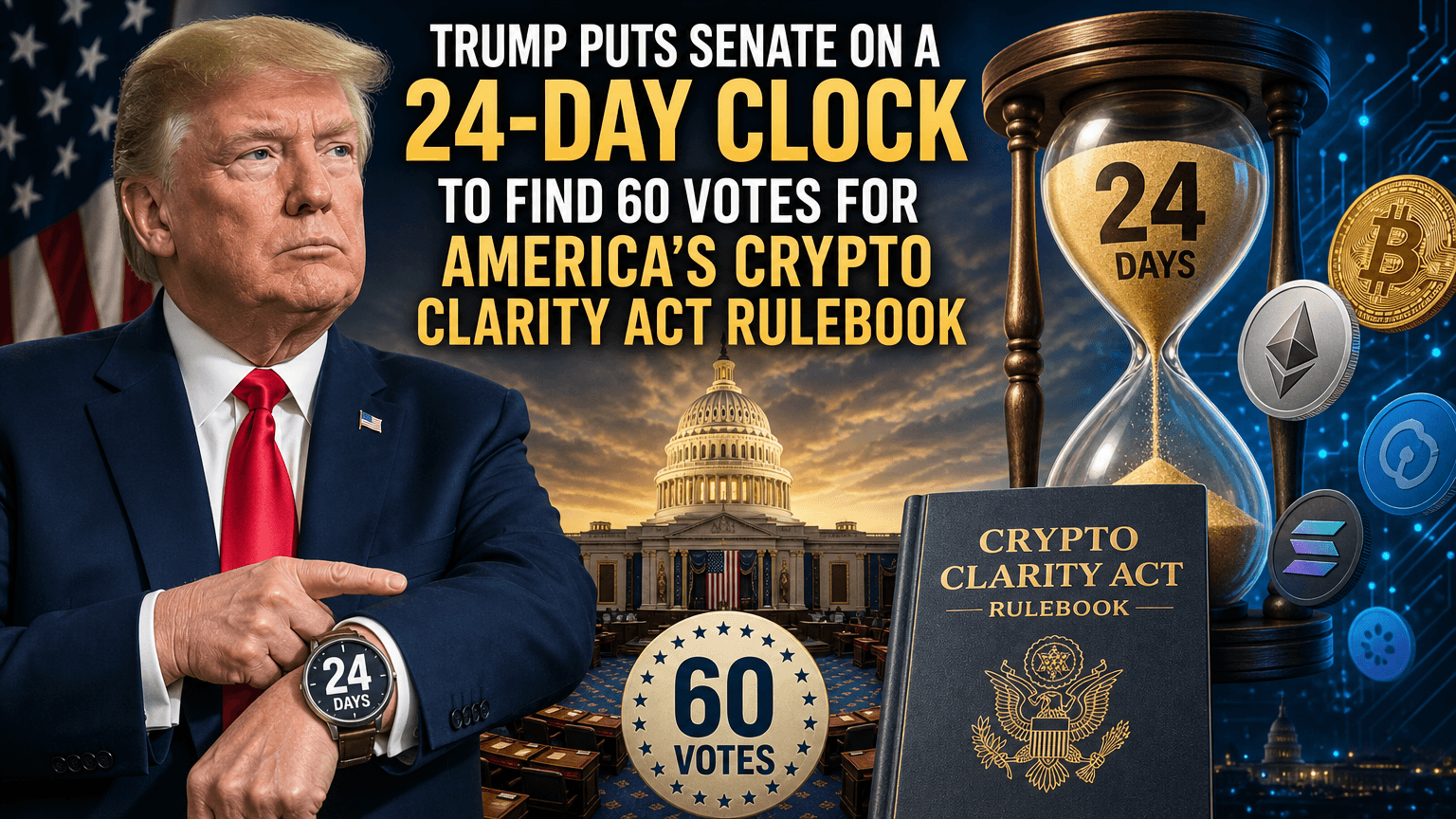
Trump puts Senate on a 24-day clock to find 60 votes for America's crypto CLARITY Act rulebook
15 July 2026
Introduction: The Growing Urgency for the CLARITY Act
As the legislative clock ticks towards the August recess, the White House is ramping up efforts to push the Senate towards passing the CLARITY Act. This legislative proposal aims at establishing a comprehensive framework for the regulation of cryptocurrencies and digital assets within the United States. The urgency surrounding the bill has been highlighted by President Donald Trump, who has positioned this measure as a key competitive strategy against China in the burgeoning fields of cryptocurrency and artificial intelligence. The CLARITY Act's passage is seen as a critical step in cementing the United States' leadership in these areas.
The Clash Over Ethics, Stablecoin Rewards, and Developer Protections
Despite the push from the White House, several unresolved issues threaten to derail the passage of the CLARITY Act. Disputes over government ethics related to digital asset engagements, provisions for stablecoin rewards, and protections for software developers have emerged as significant stumbling blocks. Democratic negotiators are particularly focused on implementing conflict-of-interest provisions to restrict government officials from benefiting financially from the digital assets market while in office. This debate has gained further traction due to President Trump's personal financial disclosures, which revealed substantial earnings from crypto-related ventures. In response, Democratic figures like Senator Elizabeth Warren have advocated for stringent restrictions to ensure impartiality in policymaking.
Banking Industry Concerns and the Stablecoin Debate
The banking industry has also raised concerns over the legislation's approach to stablecoin rewards. They argue that the existing regulatory framework could allow crypto platforms to offer financial products that mimic traditional banking yields without adhering to comparable regulatory standards. The Independent Community Bankers of America (ICBA) has actively campaigned against what it perceives as favorable treatment for crypto companies. Meanwhile, crypto advocates assert that the banking sector is attempting to stifle competition, urging lawmakers to distinguish between passive interest products and rewards generated through active participation and liquidity provision.
Developer Protections: Balancing Innovation and Regulation
The CLARITY Act also includes provisions aimed at protecting software developers from being categorized as money transmitters when they create or maintain decentralized systems without handling customer funds. This protection is crucial for fostering innovation within the cryptocurrency space. However, it raises concerns among certain law enforcement bodies about the potential for financial crimes such as money laundering and sanctions evasion. Despite this, the National Organization of Black Law Enforcement Executives (NOBLE) has endorsed the Act, viewing it as a tool that would enhance regulatory transparency and aid in financial crime investigations.
The Legislative Impasse and the Race Against Time
The unresolved issues around ethics, stablecoin regulation, and developer protections create a challenging landscape for Senate leaders. They must form a bipartisan coalition capable of securing at least 60 votes to advance the bill, which demands a delicate balance of negotiations to satisfy diverse political and industry demands. The current division in the Senate makes it difficult to project the Act's fate, especially given that only a small number of Democrats have shown tentative support. With the legislative calendar shrinking and midterm elections on the horizon, the window for passing the CLARITY Act is increasingly narrow, underscoring the urgency of resolving these disputes.
The Political and Economic Stakes
The outcome of this legislative battle carries significant implications not only for the domestic digital asset market but also for America's position in the global financial landscape. As other nations, notably China, intensify their focus on cryptocurrency and artificial intelligence, the passage of the CLARITY Act represents a strategic imperative to maintain technological and economic leadership. However, the path to achieving this involves intricate political maneuvering and compromises across the legislative aisle. The administration and crypto industry stakeholders remain hopeful, while contentious debates continue to shape the legislative discourse as the deadline looms.
In essence, the CLARITY Act embodies a pivotal moment for the future of digital assets in the United States, highlighting the intricate intersection of ethics, innovation, and regulation. The coming weeks will be crucial in determining whether the Senate can reconcile these contentious issues and advance a comprehensive regulatory framework that meets both economic and technological goals.
Go to all articles
Read more
21 August 2026
Bitcoin surges 12% crosses $70,000: 5 key drivers behind the rally
19 August 2026
Bitcoin climbs towards $64,000 as cooling inflation and falling treasury yields aid recovery
17 August 2026
INSTITUTIONAL | Israel's Largest Bank Becomes the First Bank to Offer Crypto Trading
14 August 2026
Swissquote shares sink 10% as crypto slump prompts 2026 guidance cut By Investing.com
12 August 2026
Robinhood adds over 50 tokens to become an 'all-in-one' UK platform - AMBCrypto
10 August 2026
'I Thought It Was a Cambodia Trip': Sanitation Worker's Court Lie Brings Perjury Conviction
07 August 2026
After Earnings, Is Coinbase Stock a Buy, a Sell, or Fairly Valued?
05 August 2026
Hong Kong Woman Loses $3.3 Million in Fake Crypto App Romance Scam
03 August 2026
Cardano Climbs 10% As Investors Gain Confidence By Investing.com
31 July 2026
Why Is Robinhood Stock Rising Today? Strong Trading Activity Helps Beat Earnings Despite Crypto Slowdown
29 July 2026
Flipster Secures VARA Full Operational Exchange License, Advancing Regulated Crypto Services in the UAE
27 July 2026
XEM Sees 11.83% Slide Amid Mixed Crypto Market Signals
Do you need a customized plan for trading?
Effective assistance on various aspects of your trading account and other financial activities related to trading on the broker's platform.